dreaming of a new, queerer, world
The Most Illustrious Chapel of the Divine and Holy Pleasures of the Centurion and his Beloved Pais and the Holy Arrows that Pierced Saint Sebastian that Dispel Plagues (Don’t call my name, Alejandro)
2024 - (ongoing). Installation of found objects including faux flowers, athletic cups, jockstraps, briefs, boxers, football jerseys, football cleats, running cleats, baseball cleats, wrestling shoes resin Greco-Roman statues, ceramic vases, glass vases, brass crosses, brass reliquaries, gold-tone candelabras, laserjet prints, photomontages, running shorts, baseball socks, football socks, athletic socks, baseballs, footballs, plastic fruit (including peaches, starfruit, apples, lemons, limes, mangoes, bananas), plastic lettuce leaves, wrestling singlets, baseball jerseys, towels, lockers, wooden table, wooden benches, baseball glove, lube, poppers, museum putty, shoe boxes, gold-tone plate, gold-tone plate holder, gold-tone crown, wrestling trophy, St. Sebastian medal, gold resin frame, gold-tone trophy, baseball belt, baseball pants, red football pants, blue football pants, and other various objects, custom olfactory elements, soundscape of 8:50:32, dimensions variable.


The Most Illustrious Chapel of the Divine and Holy Pleasures of the Centurion and his Beloved Pais and the Holy Arrows that Pierced Saint Sebastian that Dispel Plagues (Don’t call my name, Alejandro) began as my Master of Fine Arts thesis at the School of the Art Institute of Chicago and has since developed into a sustained project of theological and sculptural construction. What began as an inquiry into objects has expanded into an attempt to build a church.
The work is structured around two architectural and social spaces that have shaped my body and my desires: the church and the locker room. I understand both as sites in which homophobia and homoeroticism are produced simultaneously. In the church, this tension emerges through medieval, Renaissance, and Mannerist approaches to the erotics of liturgy: phallic pilgrimage tokens, devotional images of Christ and Saint Sebastian rendered as lithe, twink-like bodies, and an iconography saturated with martyred flesh, penetration, ecstasy, and ritualized bodily submission. In the locker room, these dynamics appear through communal showers, exposed bodies, “bros being bros,” and covert glances. Both spaces deny queerness even as they relentlessly generate it. This installation is constructed from the collision of those denials.
At the center of the installation rises a cathedral in miniature. Objects tower, stack, lean, and accumulate: lockers become bell towers, sports equipment forms the fabric of the altar, and condoms function as the eucharist. Many of the materials originate within institutions and contexts shaped by homophobia. I reclaim them not by neutralizing their violence, but by rerouting their meaning toward pleasure, devotion, and joy. This joy is not innocent. It is hard-won, confrontational, and slightly kinky.
My practice is grounded in citation, symbolism, and the conviction that objects are imbued through contact, use, desire, and memory. Nothing here is incidental. Every object carries charge and reference.
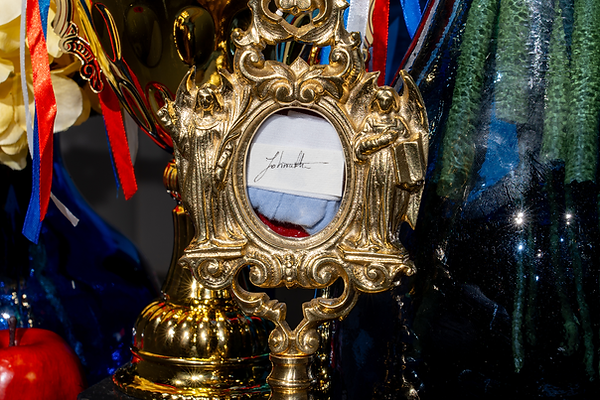
Throughout the installation are reliquaries. In Catholic tradition, reliquaries are devotional vessels that hold bodily fragments or objects associated with saints and martyrs, functioning as intercessory devices—a piece of heaven on earth that mediates between the living and the divine. The reliquaries in my installation contain objects tied to specific sexual experiences drawn from my own life: losing my virginity, an encounter with a priest in the Vatican, relationships with significant lovers, moments of intimacy now inaccessible except through their remains. Underwear exchanged with sexual partners functions as relic. Though this practice has only recently been formalized it began with my first lover, a Brit named Harry, who insisted we trade underwear to remember each other across the seas. Each pair of underwear once touched another body. That body is now absent. What remains is matter saturated with memory, desire, and loss.
Flowers recur throughout the work as references to altar arrangements. Each was selected for its connection to gay history and symbolism. The pansy recalls a slur. The hyacinth references the myth of Hyacinthus and Apollo. The calla lily operates as an homage to Robert Mapplethorpe, its phallic stamen foregrounded. The spilling and towering abundance of flowers also gestures toward the Garden of Eden. Here, homophobia is transformed into utopia.
Collage likewise spills across the installation, plastered onto surfaces to evoke church frescoes, altarpieces, icons, and locker-room pinups. Each panel is a self-portrait. This is a church built for me, and so I occupy its center as doctor of the church, porn model, saint, and devil. Like the medieval cathedral as a book of stone—the Bible of the poor—these images instruct devotees in pleasure, devotion, and play.
While inhabiting this work, I return repeatedly to the concept of sanctuary. Traditional churches have never been sanctuaries for me; they have been spaces of danger, shame, and exclusion. This installation is my sanctuary: the heart of a new queer theology.
That theology emerges from research into queer and liberation theologies and began with an examination of moments of queerness within the Bible, doctrine, and Church writings. Central to this inquiry is a reinterpretation of the Eucharist. The Eucharist commands remembrance through consumption: Christ breaks bread and declares it his flesh, pours wine and declares it his blood, and distributes both to his disciples, who then take these into their mouths. Catholic doctrine insists upon transubstantiation—the literal transformation of bread and wine into flesh and blood at the moment of consumption.
I take this claim seriously.
Thus, the Eucharist is a ritual of receiving the body through the mouth. The participant kneels. The priest penetrates the participant’s mouth with the host. Even in abstraction, this act remains erotically charged and deeply analogous to fellatio. This is not the only homoerotic ritual on the final night of Jesus’ life. I argue that the washing of the disciples’ feet functions as a euphemism for sexual intercourse.
Throughout the Old Testament, feet operate as stand-ins for genitalia: Ezekiel describes Jerusalem as a harlot uncovering her feet; Saul “covers his feet” when he urinates; Ruth seduces Boaz by uncovering his feet. Within this linguistic tradition, foot washing is not a neutral but euphemism.
In John 13, Jesus removes his garments, wraps himself in a towel, and kneels before each disciple. He takes their feet into his lap, washes them, and dries them with the same towel draped around his naked body. To dry their feet, he must lift the towel’s edge, echoing the above euphemisms for sexual exposure. While this act is often read as servitude, aligned with feminized devotional labor, I argue instead that it marks a shift in erotic positioning. Earlier, Jesus penetrates the disciples’ mouths; here, Jesus is the one being penetrated.
Scholars such as Tat-Siong Benny Liew have explored the queering of gender in this scene, though such readings often remain tethered to heteronormative frameworks. I insist on a more explicit queer reading. I understand Jesus as a bottom. As Liew argues in “Queering Closets and Perverting Desires”, linguistically Jesus occupies the position of an empty vessel awaiting fulfillment. He is later penetrated in his side after crucifixion, a wound that medieval theology repeatedly renders as yonic or vaginal. Across these moments, Jesus is configured as a body made for penetration.
This theological reading compelled not only a new doctrine, but a space capable of housing it. A church had to be built.
Within the installation, the foot appears repeatedly through socks and shoes as reference to the above passage. Theology collides again with the locker room through the logic of fetish and foot worship. Gay fetish culture has long fixated on locker rooms and on objects such as underwear, socks, and shoes—the holy grail of imbued items. These objects stand in for the absent body. Atop one locker sits a bust of Michelangelo’s David, a gold Adidas shoe strapped across his face, he is lost in lust worshiping it.
In Catholic tradition, relics are required within an altar; they are the force that consecrates the space. Following this mandate, I created reliquaries tied to specific sexual encounters. These moments are finished. What remains are artifacts. They are trophies, yes, but also evidence—testimonies to intimacy, exchange, and loss in the face of religious homophobia.
All of these elements are repurposed and assembled into a cathedral. Flowers and lockers rise like Gothic spires. Locker interiors become chapels and altars. Collages operate as frescoes and stained glass, narrating scenes of desire, devotion, and pleasure. Sound functions as continuous liturgy with pulsing gay anthems proclaiming the gospel. This is not a metaphorical church. It is one.
I position myself as God within this space because the existing God has failed their creation. This is not an act of ego, but of necessity. If theology is built from bodies, then my body is the foundation of this one.
This work does not ask for your belief.
The old temple has already been torn down.
You are standing in the new one.